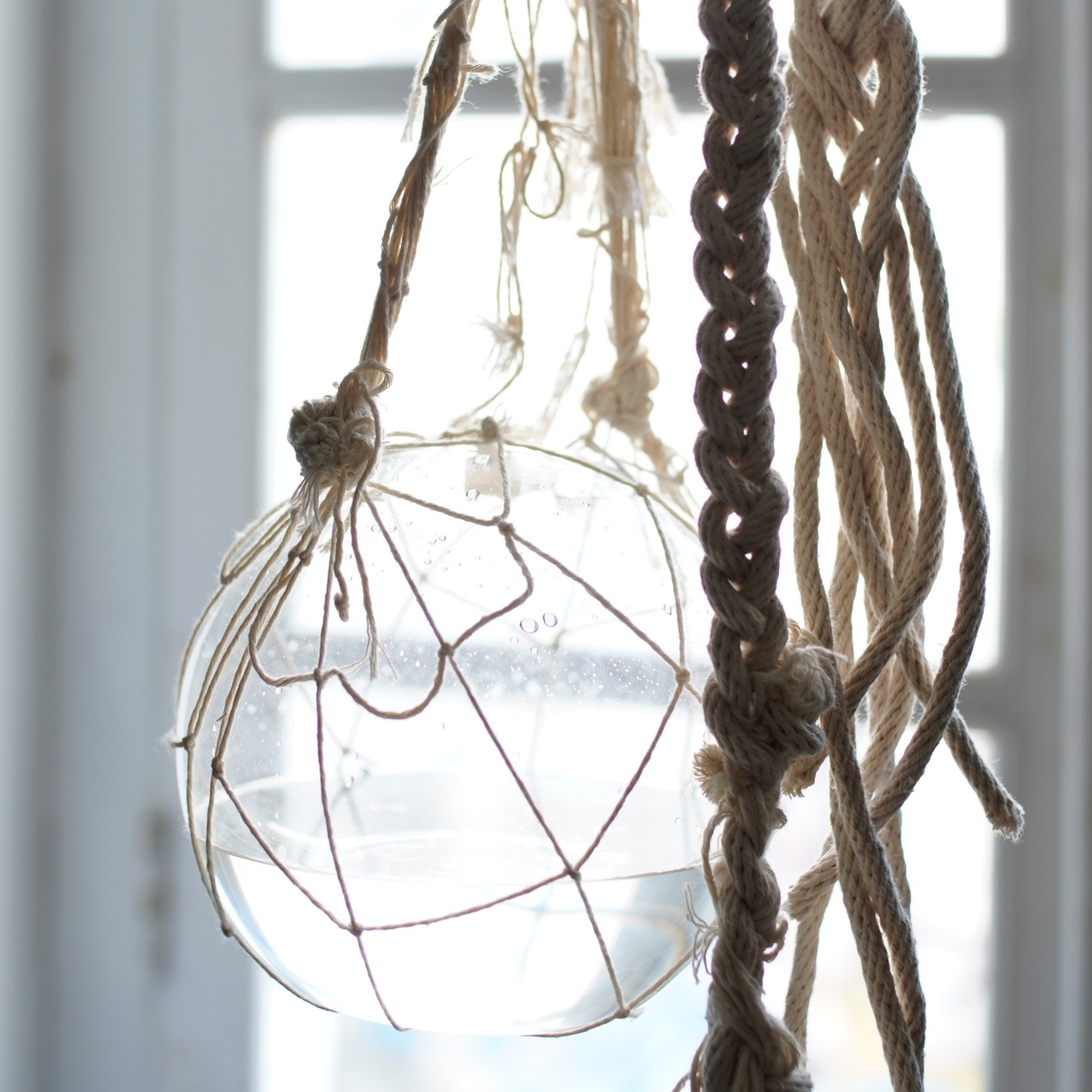
Ardora is a living light sculpture that reimagines illumination as something organic, responsive, and quietly sentient. Standing roughly 60 inches tall, the installation forms a vertical constellation of hand‑blown glass spheres—each one a delicate vessel for bioluminescent life. Suspended by braided cotton ropes, the orbs hover in space like droplets of captured moonlight, inviting viewers into an encounter that feels both intimate and otherworldly.
At the core of Ardora are bioluminescent dinoflagellates whose glow is activated through movement. When gently stirred, these microscopic marine organisms emit a soft blue light, a natural phenomenon known as bioluminescence. Their radiance is not constant but relational—appearing only in response to touch, vibration, or motion. This interactivity transforms the installation into a living dialogue between human and organism, where illumination becomes a moment of shared presence rather than a passive display.
The glass spheres—ranging from 4 inches to 6 inches in diameter, each with a small opening that allows the organisms to breathe and thrive.
Ardora invites viewers to reconsider their relationship with light—not as a mechanical output, but as a living phenomenon shaped by connection. By bringing marine bioluminescence into a human‑scaled sculptural form, the work offers a rare opportunity to witness a natural wonder up close, reminding us that illumination can be alive, responsive, and deeply intertwined with the world we inhabit.
A project by

Lolo Ostia
Ostia has exhibited internationally at museums, art fairs, and experimental film screenings across China, Cuba, France, Italy, Peru, Russia, and the United States.
She holds an Associate Degree in Spatial Design from The Fashion Institute of Technology, a BFA from Parsons School of Design, and a Master’s from NYU. Committed to expanding access to living materials education, she has led workshops on BioArt and has been a guest lecturer at NYU, Parsons, Columbia, FIT, RISD, Stony Brook, Genspace, and in Beijing. Her research on Biodesign Education has been published by Cambridge University Press. Ostia’s work has been supported by several grants including from the Foundation for Contemporary Arts, she is the inaugural recipient of the Marco Castro Cosio, Media, Art and Technology Fellowship from Columbia University’s Brown Institute.